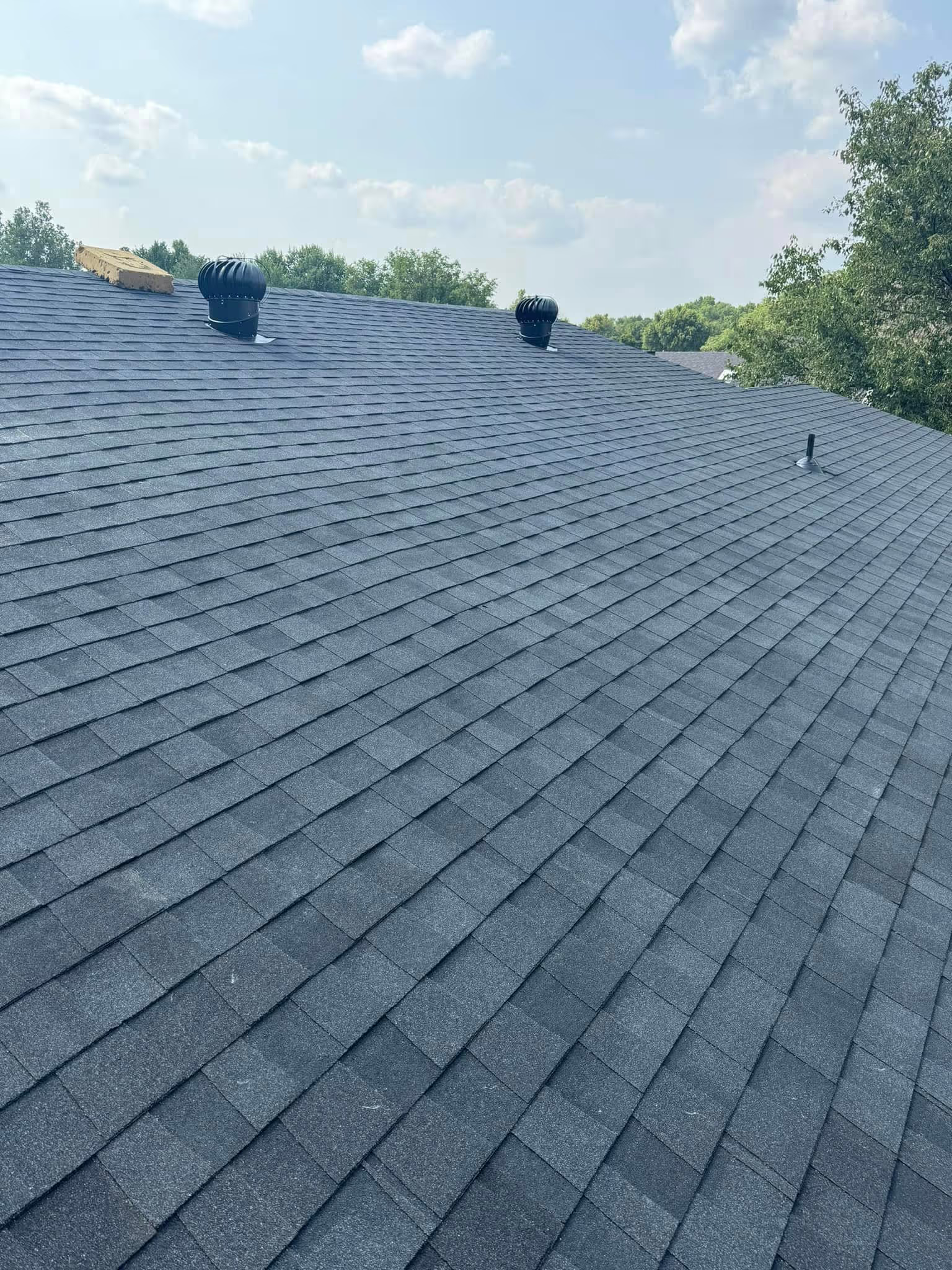
TL;DR: For 5 vs 6 inch gutters in Oklahoma, 5-inch gutters with 2x3-inch downspouts handle typical roof planes, while 6-inch gutters with 3x4-inch downspouts carry roughly 40 to 67% more water. In Oklahoma City, large or steep roof planes, long runs and valleys that dump water in one spot are the cases that call for 6-inch.
The 5 vs 6 inch gutters question on an Oklahoma home comes down to how much water each part of your roof sends to the edge, and where it lands. Most homes do fine with the standard size. Some roofs overwhelm it, and the signs show up as overflow at inside corners, splash lines on siding and soil washing out near the foundation. This guide compares the two sizes side by side, then walks through what decides the right choice for your roof. If you already know you need new gutters, our gutter replacement services page covers the work itself.
5-Inch vs 6-Inch Gutters: How Do They Compare?
This comparison assumes seamless aluminum K-style gutters in both sizes. The difference is capacity, downspout size and how they look on the fascia.
| Factor | 5-inch K-style | 6-inch K-style |
|---|---|---|
| Standard downspout | 2x3 inch | 3x4 inch |
| Water capacity | Baseline | Roughly 40 to 67% more |
| Relative cost | Lower | Higher (more material, larger downspouts) |
| Look on the fascia | Slimmer profile | Larger, more visible profile |
| Debris clogging at downspouts | More prone (smaller opening) | Less prone (larger opening) |
| Best for | Typical roof planes, simple rooflines, single-story homes | Large or steep planes, long runs, valleys that concentrate water |
Neither size is better in every case. A 6-inch gutter on a small, simple roof adds cost without solving a problem. A 5-inch gutter under a big, steep slope can overflow in a hard storm no matter how clean it is.
What Decides Gutter Size on an Oklahoma Home
Gutter size is a drainage decision, so the roof above the gutter matters more than the house as a whole. Look at each run separately.
Roof plane size and pitch
Bigger and steeper planes send more water, faster. A large slope collects more rain, and a steep one delivers it to the edge quickly enough to jump or overrun a smaller gutter. A two-story home with long, steep slopes is the classic case for 6-inch. A low ranch roof with short planes rarely needs it.
Valleys that concentrate water
A valley acts like a funnel. Where two slopes meet, the water from both runs down one channel and hits the gutter at a single point. Overflow at the base of a valley is one of the most common reasons homeowners move up a size, sometimes on that run alone.
Long runs and downspout count
Long runs need more capacity or more outlets. A long gutter has more water moving toward each downspout. The 6-inch system’s 3x4-inch downspouts drain more water and clog less easily than 2x3-inch ones. On some homes, adding a downspout to a 5-inch run solves the problem without changing the gutter size.
Trees and debris
Leaves and twigs shrink real capacity. A partly clogged 5-inch gutter overflows sooner than a partly clogged 6-inch one, and small downspouts plug first. Tree cover is heavy in parts of the metro. Edmond reports 46.2% canopy on residential land, and older areas of Bethany, Midwest City and Del City have mature trees over many roofs. Our annual roof maintenance checklist covers gutter cleaning timing.
How Oklahoma Weather Changes the Math
Oklahoma gutters handle more than rain. On low-eave ranches, gutters are often the first thing hail hits, and dented gutter lips and downspouts help document a storm’s direction and severity. They don’t prove shingle damage on their own, but they’re part of the evidence. See our guide on how to spot hail damage for what to photograph.
Metal thickness matters as much as width here. Aluminum at .032 inch is about 18.5% thicker than .027 inch, and it resists dents and sagging better under hail and ice. Ice is a real load in this part of the state. The historic October 2020 ice storm put half an inch of ice across much of the metro, and falling limbs damaged roofs and gutters from Edmond to Midwest City.
So in Oklahoma, the choice is really two decisions: the width that handles your roof’s water, and a gauge that stands up to the weather.
How to Decide on 5 vs 6 Inch Gutters for Your Home
Start with the runs that give you trouble now. If water overflows at the same corners or valleys in heavy storms and the gutters are clean, those runs likely need more capacity, a larger downspout or an extra outlet.
Then look at the home’s age and shape. Many 1950s and 1960s ranches in Midwest City, Del City and Bethany have low eaves and modest roof planes, which often suit 5-inch gutters well. Newer two-story homes with large, steep or cut-up roofs are more likely to benefit from 6-inch on at least some runs. Edmond has extensive 2000s-and-newer subdivisions, and homeowners there can see our Edmond gutter replacement page for local details.
Timing matters too:
- Planning a roof replacement? Coordinate the gutters with it so the drip edge and gutter apron go in together.
- Hail-dented gutters on an open claim? Replace them as part of the claim, not as a separate out-of-pocket job.
- Gutters sound but misbehaving? Re-pitching, re-hanging or resealing the seams may fix the problem without new gutters or a new size.
Ask any installer to explain the size they recommend for each run, the downspout size and count, and the aluminum thickness. A written estimate should list all three.
When Resizing Isn’t the Answer
Bigger gutters don’t fix every drainage problem. If water spills because a run has lost its slope, sags between hangers or leaks at the seams, a 6-inch gutter installed the same way will have the same trouble. Overflow on a clean gutter points to capacity. Overflow on a clogged gutter points to maintenance or guards. Water behind the gutter points to how it meets the roof edge.
Fascia rot, foundation erosion and ice backing up at the eaves are the real costs of getting drainage wrong. Those are worth solving at the cause.
Talk to an OKC Roofer About Your Gutters
If you’re weighing 5 vs 6 inch gutters for your Oklahoma home, start with a look at the roof that feeds them. Prodigy Restoration serves Oklahoma City and the surrounding metro, offers free roof inspections, and is BBB Accredited. Call us at (405) 730-5672 or fill out our contact form.
Frequently asked questions
Do I need 5-inch or 6-inch gutters?
Most homes with typical roof planes do fine with 5-inch gutters and 2x3-inch downspouts. Choose 6-inch gutters with 3x4-inch downspouts for large or steep roof planes, long runs, and valleys that dump water in one spot. Look at each run separately, since a home can use 6-inch on its problem runs and 5-inch elsewhere.
How much more water does a 6-inch gutter hold than a 5-inch gutter?
A 6-inch K-style gutter with 3x4-inch downspouts carries roughly 40 to 67% more water than a 5-inch gutter with 2x3-inch downspouts. The larger downspouts are a big part of that difference, because they drain the gutter faster and are less likely to clog with leaves and twigs during heavy Oklahoma storms.
Are 6-inch gutters worth it in Oklahoma?
They are worth it where a roof sends more water than a 5-inch system can carry: big or steep slopes, long runs and valley outlets. On a small, simple roof they add cost without solving a problem. If a clean 5-inch gutter overflows at the same spots in hard rain, those runs are the ones to upsize.
What gutter thickness is best for Oklahoma hail and ice?
Aluminum at .032 inch is about 18.5% thicker than .027 inch and resists dents and sagging better, which matters in a state with frequent hail and occasional ice storms. Ask any installer which gauge they use and make sure the written estimate lists it along with the gutter size and downspout size.
Should I replace my gutters when I replace my roof?
It often makes sense to coordinate them so the drip edge and gutter apron go in together. If your gutters are hail-dented and part of an open insurance claim, replace them under the claim rather than as a separate job. If they are sound, re-pitching or resealing may be all they need.
Prodigy Restoration
7140 NW 112th St, Oklahoma City, OK 73162